
Why modern AI applications are shifting from Prompt Engineering to Context Engineering, and what every software engineer can learn from that evolution.
Introduction
A little over a year ago, I was convinced that the secret to building better AI applications was learning how to write better prompts.
Like many engineers, I spent hours experimenting with different prompting techniques. I tried role prompting, few-shot examples, structured outputs, and prompt templates. Every small improvement felt like discovering another piece of the puzzle.
Sometimes changing just a few words would completely transform the quality of the response.
It was exciting.
And to be fair, it worked. But only up to a point.
Over the past few months, I started building something more ambitious than a chatbot. I wanted to build an AI-powered DevOps Study Buddy; a system capable of answering questions about AWS, Terraform, Kubernetes, and DevOps concepts using its own knowledge base instead of relying solely on the model’s pre-trained knowledge.
On paper, the architecture looked straightforward:
Simple. Or at least, that’s what I thought.
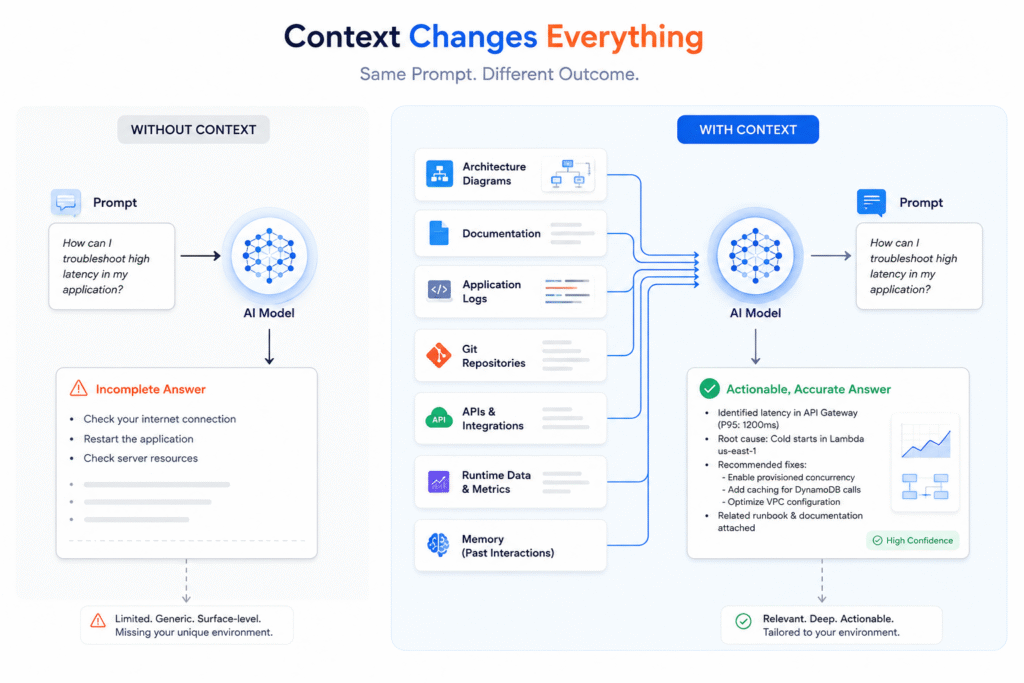
As the project evolved, I found myself spending surprisingly little time writing prompts. Instead, I was asking completely different questions:
Without realizing it, I had stopped doing prompt engineering. I had started doing something much broader.
I was engineering context.
That realization completely changed how I think about building AI applications.
Today, when an AI system gives me a poor answer, my first question is no longer:
“How can I improve this prompt?”
Instead, I ask:
“Did I give the model enough relevant context to succeed?”
More often than not, the answer lies there.
The Prompt Engineering Boom
Context Engineering is becoming one of the most important skills in modern AI. Yet only a few years ago, almost everyone was focused on Prompt Engineering.
Soon, social media was flooded with prompt libraries, cheat sheets, and viral examples promising better AI responses. Techniques like “Act as a Senior Software Engineer,” “Explain it like I’m five,” and “Think step by step” became common. Researchers introduced methods such as Zero-Shot, Few-Shot, Chain-of-Thought, Self-Consistency, and ReAct, all of which significantly improved how developers interacted with large language models.
Prompt engineering quickly became one of AI’s hottest skills. Entire websites collected prompts, companies explored hiring Prompt Engineers, and courses claimed to reveal the “perfect” prompting techniques. For the first time, developers could influence a powerful AI system simply by refining natural language instructions and it genuinely felt revolutionary.
The biggest lesson was simple: better instructions usually produce better responses. That principle is still true today.
But as AI evolved, so did software engineering.
Developers stopped building standalone chatbots and started building intelligent systems. AI was no longer answering isolated questions; it was connected to documentation, source code, APIs, databases, cloud infrastructure, monitoring platforms, version control, and business workflows.
The challenge was no longer just writing better prompts.
It became about providing the right context at the right time.
The engineering focus shifted from prompt optimization to system design, context management, and orchestration. Prompt engineering remains valuable, but in modern AI applications, it is only one part of a much larger architecture.
The Quiet Shift
Imagine asking an AI assistant:
“Why is my Terraform deployment failing?”
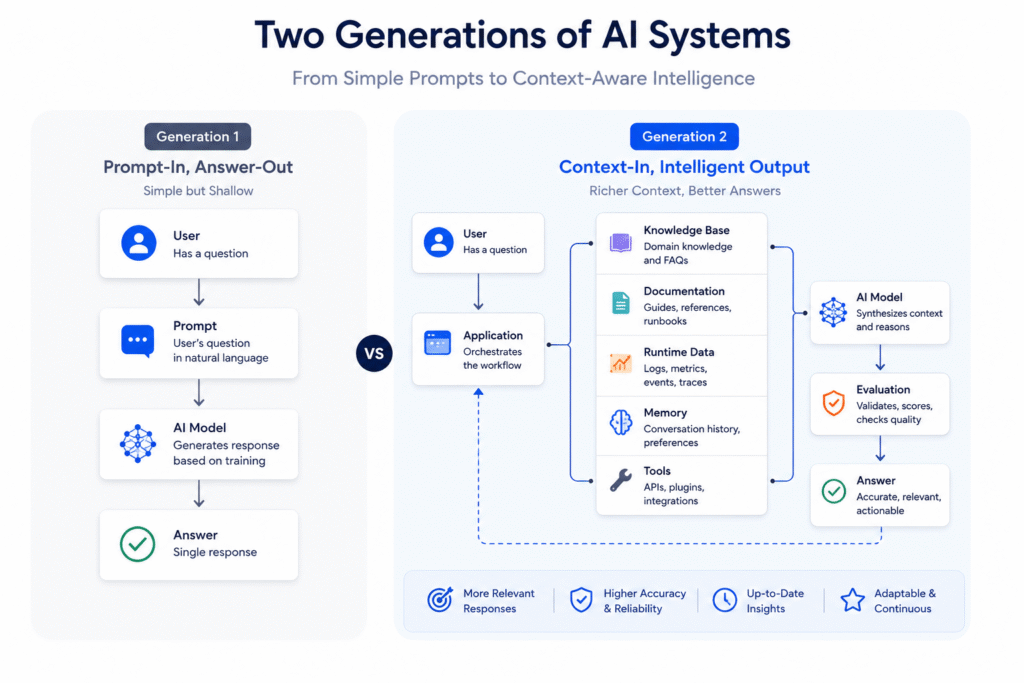
Even if you’ve written a beautifully crafted prompt, the model still lacks critical information.
It doesn’t know:
In other words, the model isn’t failing because the prompt is weak. It’s failing because it doesn’t have the information required to reason about your problem. This distinction seems small.
In reality, it’s one of the biggest mindset shifts happening in AI engineering today.
As engineers, we’ve spent years learning how to debug distributed systems, investigate production incidents, and troubleshoot infrastructure failures.
We know that solving problems isn’t about asking better questions; it is about collecting the right evidence.
AI systems are no different.
The better the context, the better the reasoning.
The better the reasoning, the more reliable the outcome.
Prompt engineering didn’t disappear.
It simply became one part of a much larger discipline.
That discipline is increasingly being referred to as Context Engineering.
And understanding that shift may be one of the most valuable skills software engineers can develop over the next few years.
The Problem Nobody Talks About
If you’ve worked as a software engineer, you’ve probably experienced this.
You ask an AI assistant a technical question. It responds confidently, the explanation sounds convincing, and everything looks correct. But when you actually try the solution, it doesn’t solve the problem.
Our first instinct is usually to blame the model.
“ChatGPT isn’t good at Terraform.”
“Claude doesn’t understand Kubernetes.”
“Copilot generated the wrong code.”
Sometimes that’s true. More often, though, the model is trying to solve a problem with only a fraction of the information that an experienced engineer would ask for.
Take a common prompt:
“My Terraform deployment is failing. Help me fix it.”
Now imagine asking the same question to one of your teammates. They wouldn’t immediately suggest a fix. Instead, they’d ask questions:
- Which cloud provider are you using?
- What’s the exact error message?
- Which Terraform version?
- Are you using a remote backend?
- Is this failing locally or in your CI/CD pipeline?
- Did anything recently change?
Experienced engineers don’t begin by solving the problem; they begin by collecting context.
Large Language Models work the same way. Without enough context, they have no choice but to make assumptions. Sometimes those assumptions are correct. Sometimes they lead to completely different solutions. The quality of the answer depends largely on the quality of the information you provide.
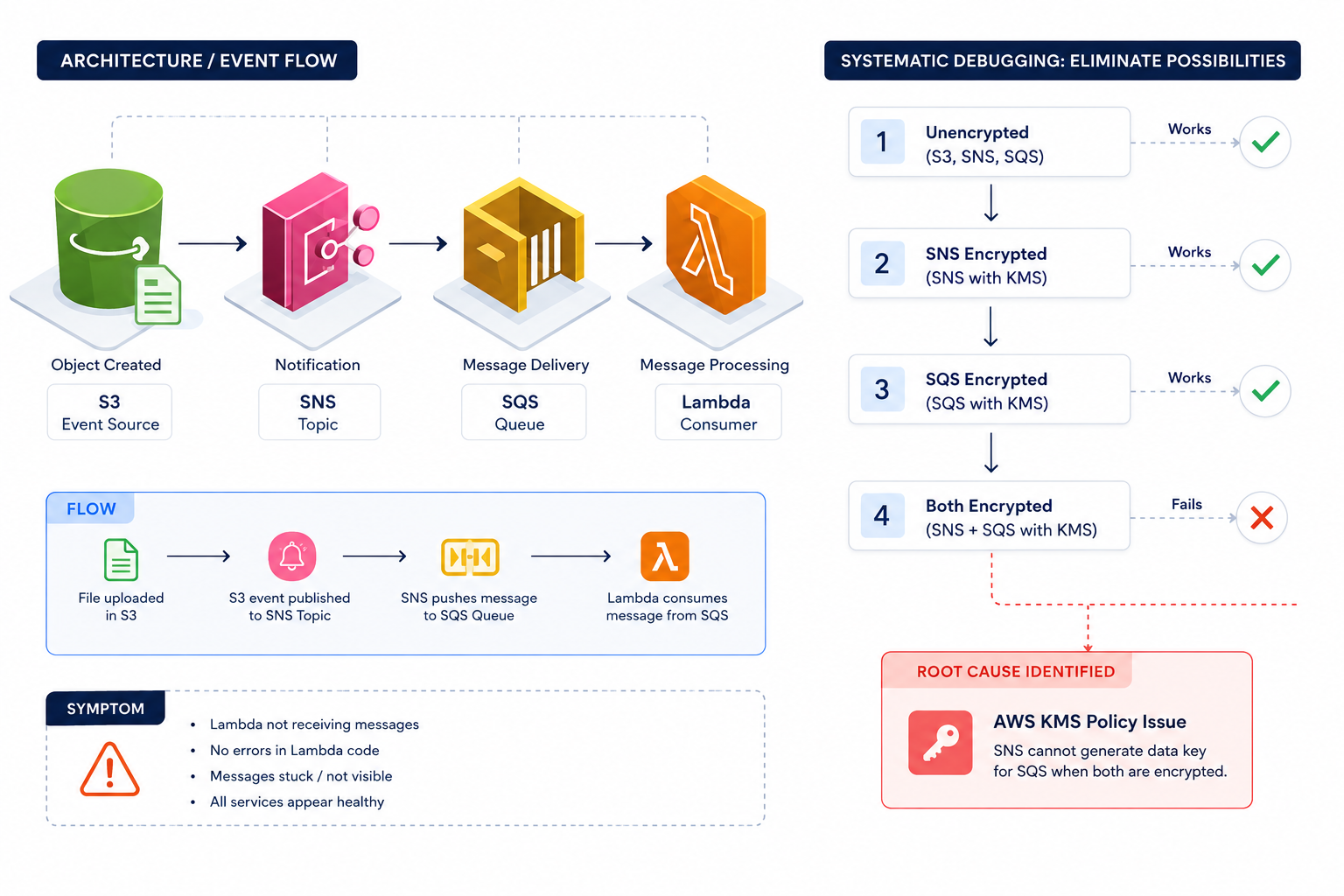
I learned the same lesson during a production incident involving a cross-account AWS event-driven architecture. The pipeline looked straightforward: Amazon S3 → Amazon SNS → Amazon SQS → AWS Lambda. Whenever a file landed in an S3 bucket, it was supposed to trigger a Lambda function in another AWS account.
Instead, nothing happened.
Rather than changing random configurations, we investigated methodically. We first removed encryption, and the pipeline worked. We then enabled encryption only on SNS;it still worked. Next, we encrypted only the SQS queue; again, no issues. But the moment both SNS and SQS were encrypted together, the pipeline failed.
That single observation narrowed the entire investigation. The problem wasn’t Lambda, Amazon S3, or cross-account IAM permissions. It was the interaction between encrypted SNS messages, encrypted SQS queues, and AWS KMS key policies.
The breakthrough didn’t come from collecting more information. It came from collecting the right information.
That’s the same principle modern AI systems depend on. Better prompts can improve responses, but without the right context, even the most advanced model is forced to guess.
Introducing Context Engineering
Over the past two years, AI applications have quietly evolved.
The first generation of LLM-powered applications followed a simple pattern:
User → Prompt → Model → Answer
For many tasks, that worked remarkably well. But as organizations began building AI assistants for engineering, customer support, software development, and enterprise knowledge, a limitation became obvious.
Large Language Models are incredibly capable, but they don’t know your company’s architecture, internal documentation, production incidents, Git repositories, or deployment history. Without that information, even the best prompt can only take the model so far.
The solution wasn’t to write increasingly clever prompts. It was to provide the model with the information it needed before asking it to reason.
This is where Context Engineering comes in.
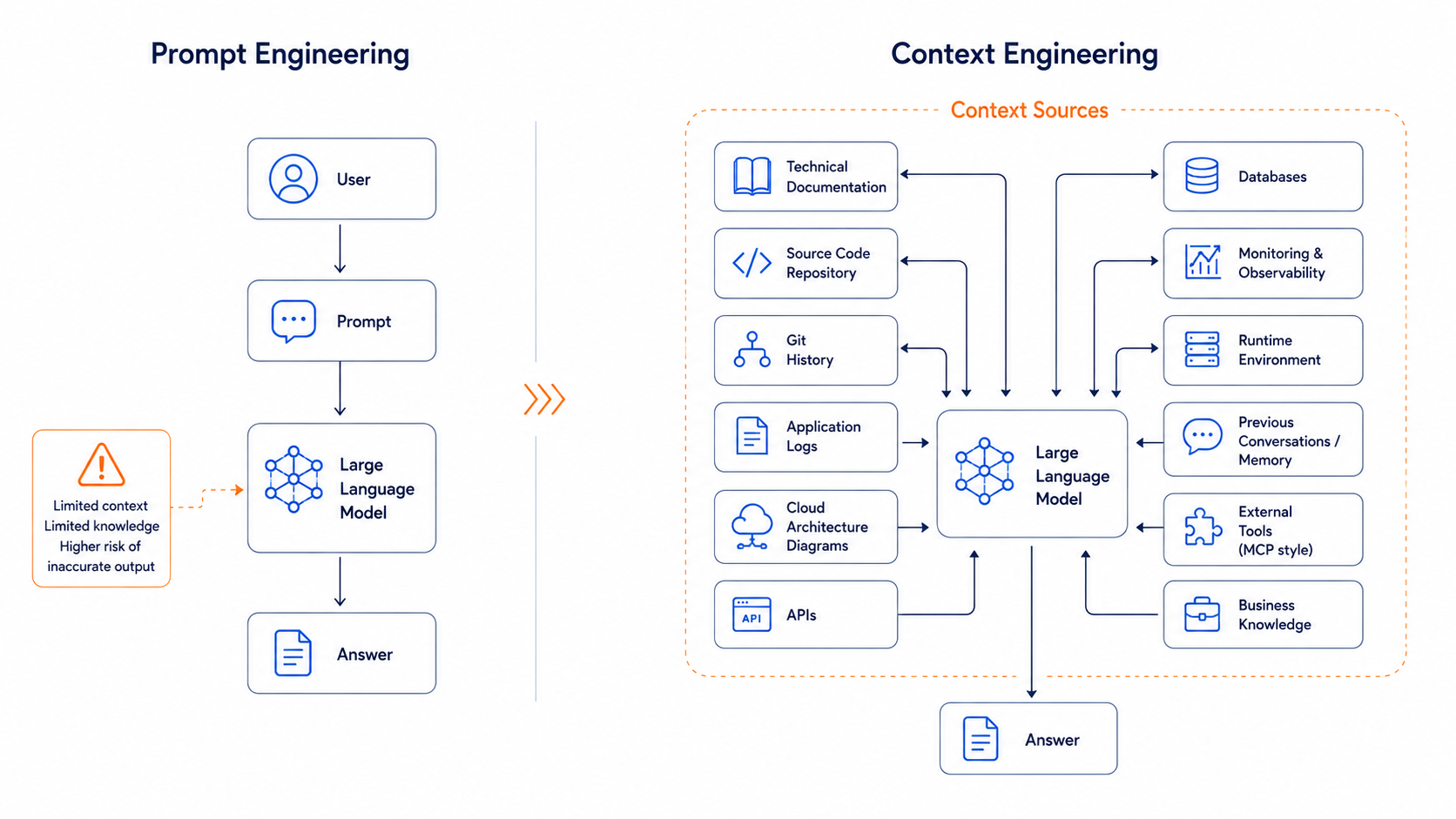
Rather than focusing only on how we ask the question, Context Engineering focuses on everything the model needs to answer it correctly.
That context might include technical documentation, application logs, architecture diagrams, API responses, previous conversations, runtime information, or even external tools that the AI can query in real time.
In other words, the prompt becomes just one component of a much larger system.
While working on my own AI projects, I found it useful to think about context as a structured stack rather than a random collection of information. That mental model eventually became what I now call the CloudInKB Context Stack; a simple framework for understanding how modern AI applications assemble knowledge before a language model generates a response.
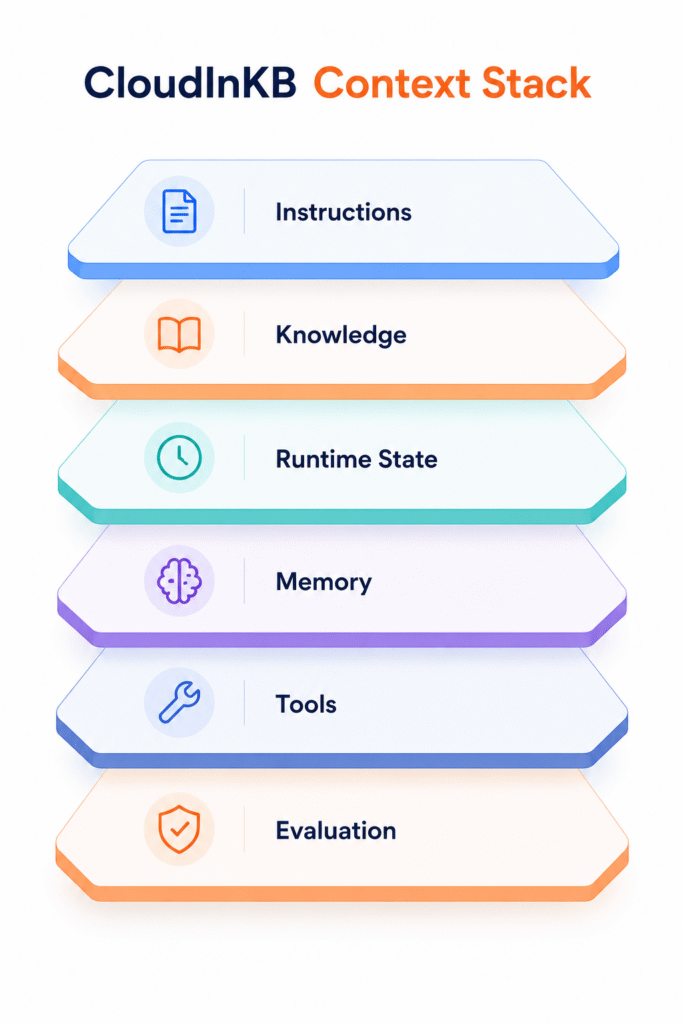
We’ll explore that framework in detail in the next article of this series.
For now, the important takeaway is this:
Modern AI applications don’t become better simply because they use better prompts. They become better because they provide better context.
Conclusion
When I first started experimenting with Large Language Models, I believed prompt engineering was the skill that mattered most.
And to be fair, it still matters.
A clear prompt, a well-defined objective, and good instructions can significantly improve the quality of an AI's response.
But building real AI applications taught me something equally important.
The hardest problems rarely came from the prompt itself.
They came from missing documentation, incomplete runtime information, poor retrieval, limited visibility into the system, or simply failing to provide the model with the information a human engineer would naturally ask for.
That realization changed the way I approach AI development.
Instead of asking,
“How can I write a better prompt?”
I now find myself asking,
“What information is the model missing?”
It’s a small change in perspective, but it leads to a very different way of building AI systems.
As software engineers, we’ve spent years designing systems that move the right information to the right place at the right time. In many ways, Context Engineering is simply the next evolution of that same engineering mindset.
The hardest problems in modern AI engineering aren’t language problems. They’re information problems.
And solving information problems has always been an engineering discipline.
In the next article, we’ll break down the CloudInKB Context Stack and explore the six layers of context that modern AI applications rely on to produce reliable, production-ready responses.