
So… Are You a DevOps Engineer or a Cloud Engineer?
A few months ago, someone asked me a simple question during a discussion:
“What exactly do you do? Are you a DevOps Engineer or a Cloud Engineer?”
I paused for a second.
The honest answer was:
“A bit of both.”
And that’s where the confusion started.
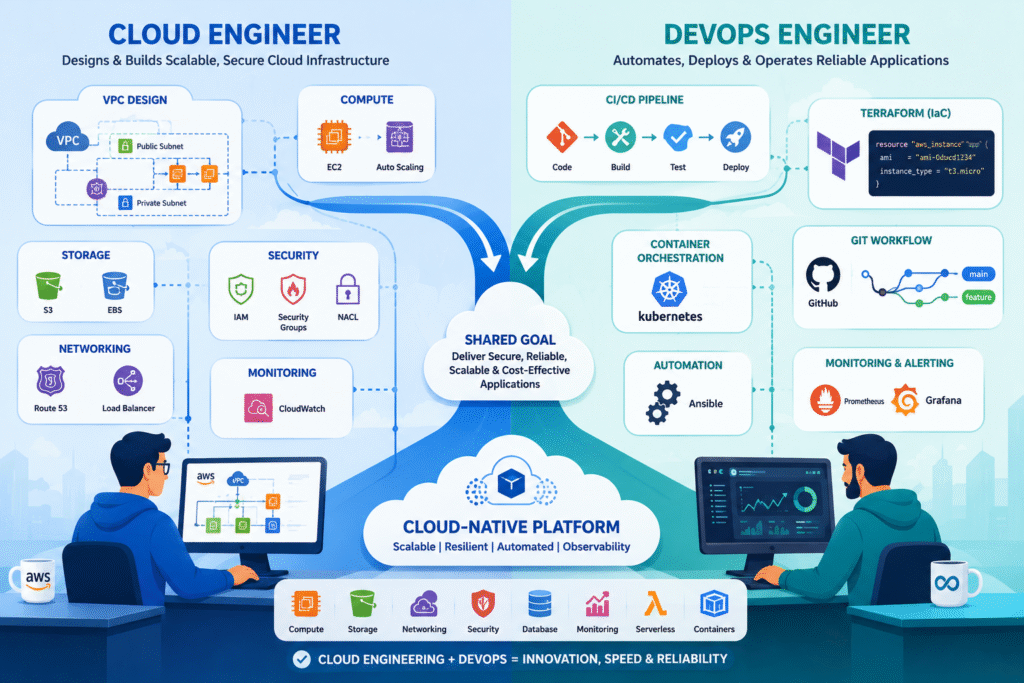
Over the years, I have worked on AWS infrastructure, built automation using Terraform and CloudFormation, managed CI/CD pipelines, supported Kubernetes platforms, troubleshot production environments, and collaborated with application teams during cloud migrations.
Some people called it Cloud Engineering.
Others called it DevOps.
The reality is that the boundary between these roles has become increasingly blurry.
Yet they are not exactly the same thing.
How I Accidentally Ended Up Doing Both
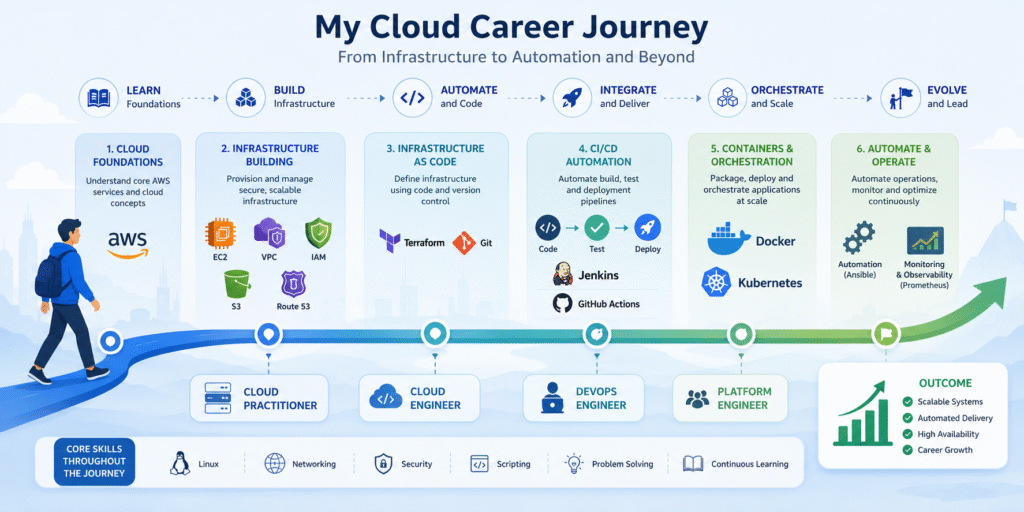
When I started working with AWS, my focus was primarily infrastructure.
I spent most of my time learning and working with:
- Amazon EC2
- VPC networking
- IAM permissions
- Load Balancers
- Amazon S3
- CloudFormation templates
My job was essentially to build and maintain cloud environments.
At that point, I was operating much closer to a Cloud Engineer.
Then something interesting happened.
Infrastructure alone wasn’t enough.
Teams wanted faster deployments.
Manual server configuration became painful.
Environmental consistency became difficult.
Repeatability became critical.
That’s when tools like Terraform, Jenkins, Git, Docker, and Kubernetes entered the picture.
Instead of simply building infrastructure, I started building systems that could build infrastructure automatically.
That was my first real exposure to DevOps.
What Does a Cloud Engineer Actually Do?
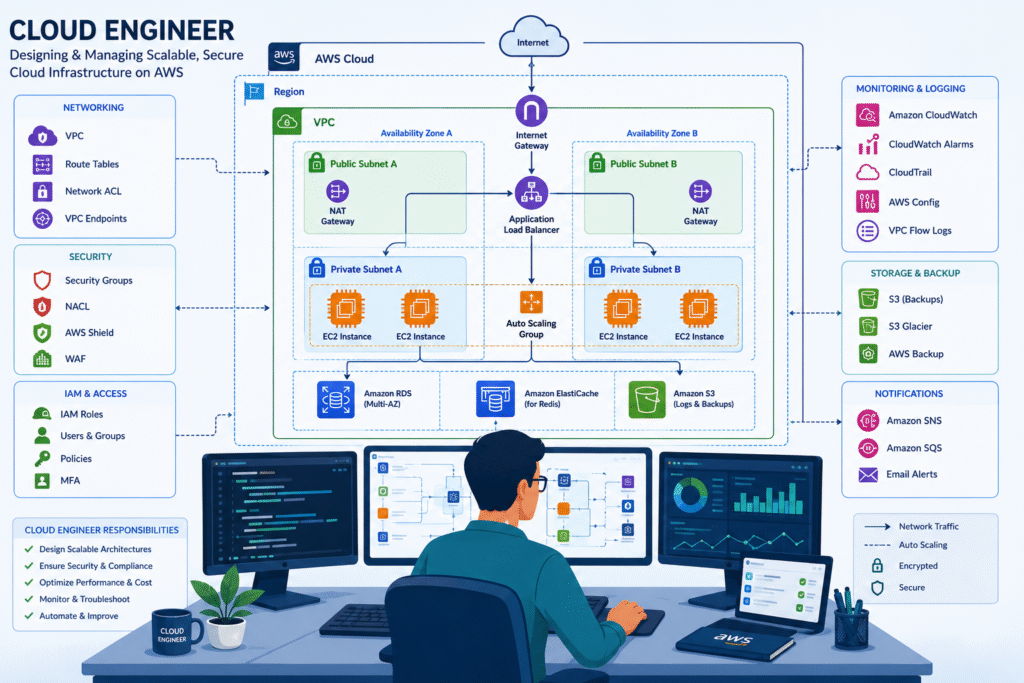
At its core, Cloud Engineering is about designing, building, and operating cloud infrastructure.
Think of Cloud Engineers as the architects and builders of the digital foundation.
Common Cloud Engineering Responsibilities
- Designing AWS, Azure, or GCP infrastructure
- Creating VPCs, subnets, route tables, and gateways
- Managing IAM roles and permissions
- Setting up compute, storage, and networking services
- Designing disaster recovery solutions
- Implementing security controls
- Optimizing cloud costs
In Simple Terms
A Cloud Engineer focuses on where applications run.
What Does a DevOps Engineer Actually Do?
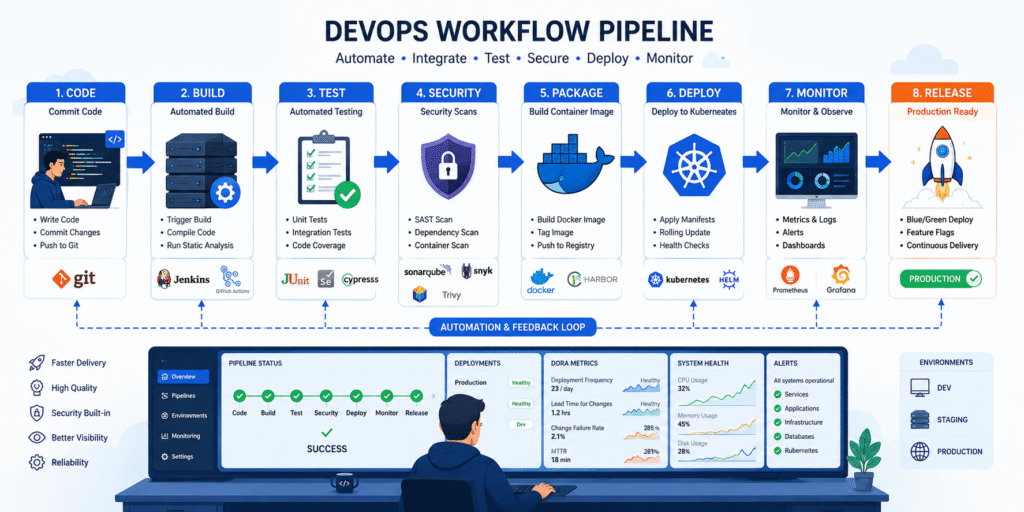
A DevOps Engineer focuses less on infrastructure itself and more on how software moves through that infrastructure.
The goal is speed, consistency, automation, and reliability.
Common DevOps Engineering Responsibilities
- Building CI/CD pipelines
- Automating deployments
- Managing Infrastructure as Code
- Working with containers
- Managing Kubernetes clusters
- Monitoring applications
- Writing automation scripts
In Simple Terms
A DevOps Engineer focuses on how applications move from development to production safely and repeatedly.
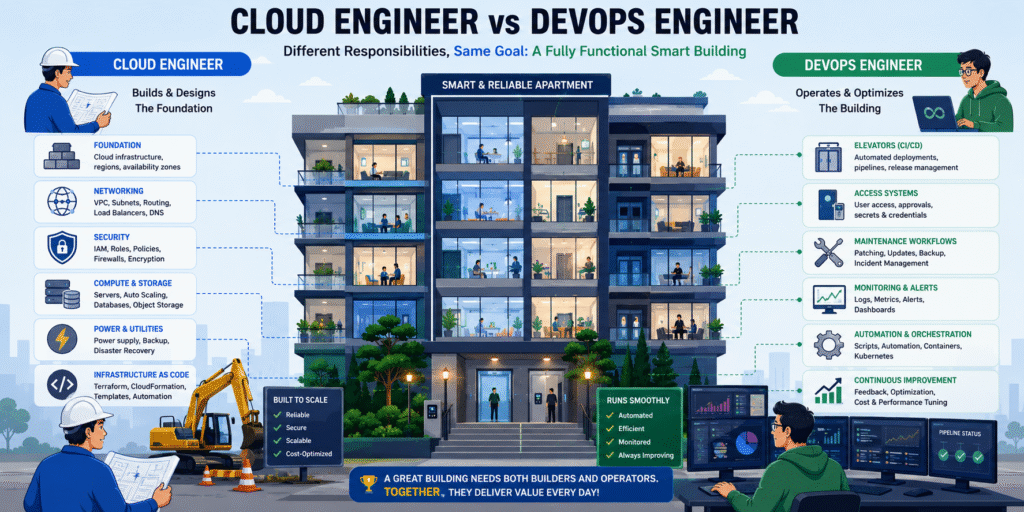
The Simplest Analogy
Imagine building a modern apartment complex.
Cloud Engineer
Builds:
- Foundation
- Electricity
- Security systems
- Water systems
- Parking
- Elevators
Without them, nobody has a place to live.
DevOps Engineer
Builds:
- Onboarding systems
- Access control
- Maintenance workflows
- Monitoring systems
- Delivery mechanisms
Without them, operating the building becomes chaotic.
Both are essential.
They simply solve different problems.
Where Things Start Overlapping
This is where many job descriptions become confusing.
Modern companies rarely keep these responsibilities completely separate.
A Cloud Engineer may write Terraform.
A DevOps Engineer may design VPC architectures.
A Platform Engineer may do both.
In many organizations today, one engineer is expected to understand:
- Cloud Platforms
- Infrastructure as Code
- CI/CD Pipelines
- Kubernetes
- Monitoring
- Security
- Automation
The title becomes less important than the capability.
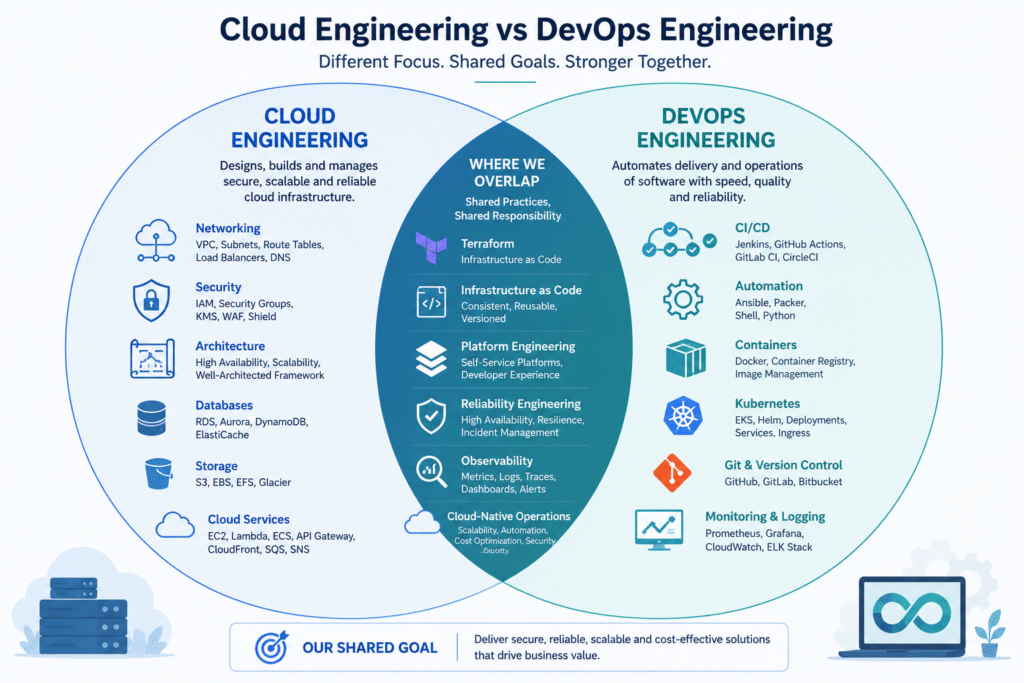
Cloud Engineering vs DevOps Engineering
| Cloud Engineering | DevOps Engineering |
|---|---|
| Infrastructure Focus | Automation Focus |
| Networking | CI/CD Pipelines |
| IAM & Security | Release Management |
| High Availability | Deployment Automation |
| Cloud Architecture | Developer Enablement |
| Cost Optimization | Monitoring & Observability |
Which Career Path Should You Choose?
If you enjoy:
- Architecture
- Networking
- Security
- Cloud Services
Cloud Engineering may feel more natural.
If you enjoy:
- Automation
- Scripting
- CI/CD
- Kubernetes
DevOps may feel more exciting.
But I wouldn’t force myself into choosing only one.
The industry is increasingly moving toward engineers who understand both.
My Suggested Learning Path
- Linux
- Networking
- AWS Fundamentals
- IAM & Security
- Git
- Terraform
- CI/CD Pipelines
- Docker
- Kubernetes
- Monitoring
- Automation with Python
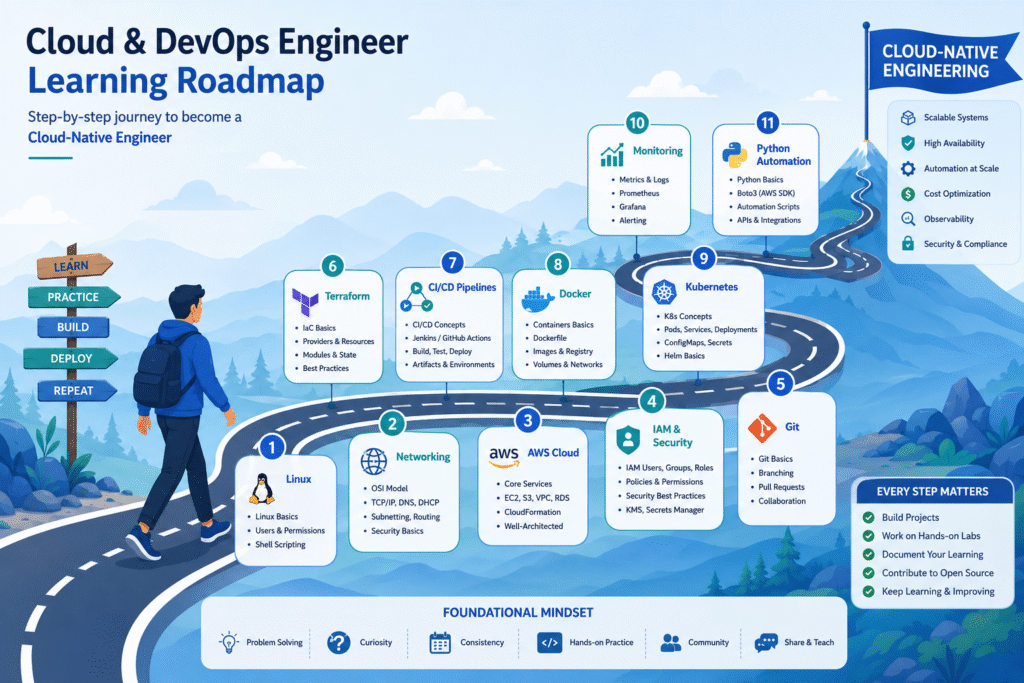
This path naturally develops both Cloud Engineering and DevOps skills.
Final Thoughts
After working with AWS infrastructure, Terraform, Kubernetes, CI/CD pipelines, automation, and production support, I’ve reached a simple conclusion:
Cloud Engineering and DevOps are not competing career paths. They are complementary skill sets.
Cloud Engineering gives applications a secure and scalable home.
DevOps ensures software can reach that home quickly, safely, and repeatedly.
The most effective engineers I’ve worked with understand both.
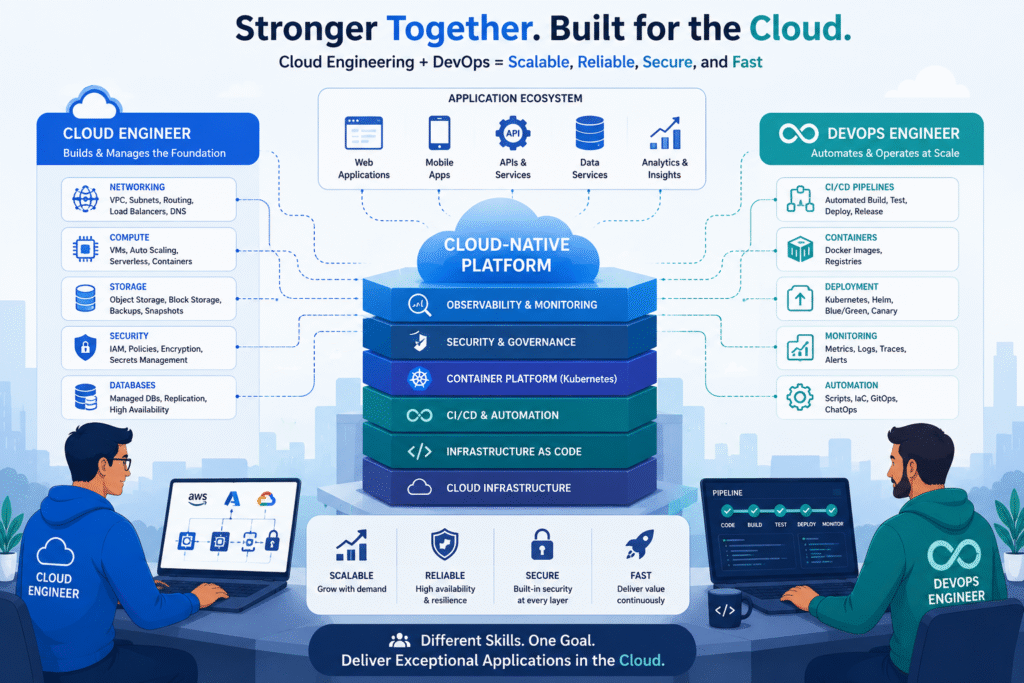
And in today’s cloud-native world, that’s becoming less of an advantage and more of an expectation.
So if you’re wondering whether to learn Cloud Engineering or DevOps, my answer is simple:
Start with one. Eventually, learn both.
Because that’s where some of the most interesting work in modern technology happens.